
Humans in Command: Building Resilience Beyond Technology

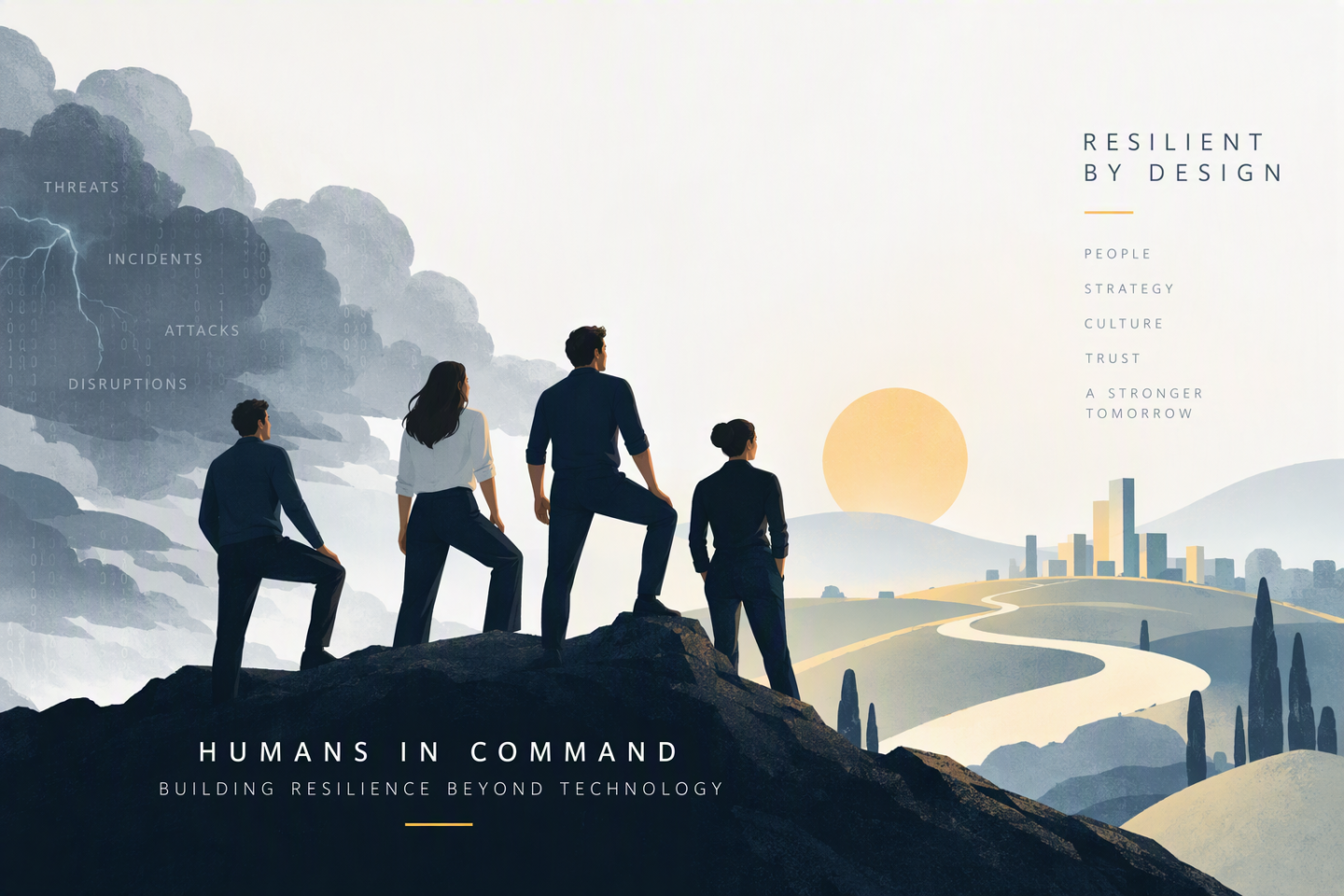
For many years, organizations have invested heavily in detecting incidents, responding to attacks and recovering from disruptions. While these capabilities remain essential, the discussions throughout the BE-CYBER 2026 day pointed towards a different question: How do we build systems that are resilient by design?
Reflections from BE-CYBER 2026 on sovereignty, resilience and our increasingly interconnected world – part 1
From Reaction to Resilience
We have received more than enough wake-up calls. Geopolitical tensions, supply chain disruptions, cyberattacks against critical infrastructure and the rapid acceleration of artificial intelligence have all highlighted the fragility of our interconnected systems.
The challenge is no longer simply to respond better when things go wrong. The challenge is to create environments capable of absorbing shocks while continuing to operate.
True resilience requires more than technology. It depends on governance, collaboration, trust and shared responsibility. It also cannot be built in isolation. This year's invitation of Canada as partner country served as another reminder that cyber resilience increasingly transcends national borders.
Reclaiming Human Control
One of the most thought-provoking sessions was delivered by David Shipley of Beauceron Security.
Drawing from etymology, history, philosophy and practical cybersecurity experience, Shipley challenged several assumptions that have become deeply embedded in our industry. One of these was the familiar expression that "the problem sits between the keyboard and the chair."
The statement is often repeated in cybersecurity circles, usually as a humorous reference to human error. Yet it reveals an underlying mindset: that people are the weakest link.
David argued the opposite.
Technology should not be designed around the expectation that humans will fail. Technology should empower humans to succeed.
His perspective was encapsulated in a powerful statement: Technology is craft with intent.
This simple phrase shifts responsibility. Technology is not an autonomous force shaping society independently of our choices. It is created, deployed and governed by people.
Perhaps even more relevant in the age of generative AI was his invitation to change the conversation. Instead of asking only what AI does to our code, our productivity or our business models, we should also ask:
What does AI do to our minds?
As organizations rush to embrace AI capabilities, questions of human judgement, critical thinking and decision-making become increasingly important. We may soon discover that preserving human agency will be one of the defining leadership challenges of the coming decade.
Or, as David Shipley summarized it: Humans must be in command, not just in the loop. But are our systems designed to help people succeed?
Our next article turns from human control to the infrastructure and dependencies that organizations rarely see but cannot operate without.
Anne Wanielista
Anne is a multilingual Project & Change Manager with experience in digital transformation across energy, pharma, ICT, security, and transport. She has worked within various European institutions.
A commercial engineer by training, she never stopped learning — holding university certificates in strategic intelligence, foresight, and security intelligence analysis, alongside advanced studies in Security & Defence.
She has a particular passion for security, which extends beyond her professional life: she is a certified Krav Maga instructor — the Israeli self-defence system. Now bridging physical security and cybersecurity, she is turning that passion into her next chapter.